Founded 2004
Facebook Almost Got Its Founder Expelled — Before It Even Existed
The prank that came before Facebook, the dorm room, and the $500,000 phone call that changed everything.
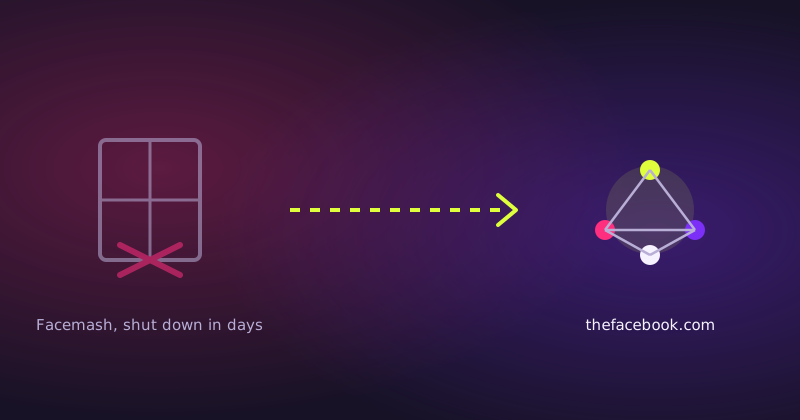
Before there was a Facebook, there was almost an expulsion. Nineteen-year-old Mark Zuckerberg built something called Facemash — a site where Harvard students could rate classmates' photos against each other. It spread across campus overnight, it was genuinely controversial, and the university shut it down within days.
Hold up — how does a guy get one prank site shut down by the entire university and then, what, two years later launch the biggest social network on the planet? Turns out almost getting expelled is not actually a career-ender if the thing you build next is good enough. Noted.
From a prank to a real idea
Zuckerberg was hauled in front of the administrative board and, by his own account, genuinely thought he might get sent home. He didn't. And the mess of Facemash left him with a much better question: what if there was a real, sanctioned version of that same idea — not ranking classmates against each other, just letting them build a profile and exist online together?
On February 4, 2004, working out of Kirkland House dorm room H33 with roommates Eduardo Saverin, Dustin Moskovitz, Andrew McCollum, and Chris Hughes, Zuckerberg launched "TheFacebook." Within 24 hours, hundreds of Harvard students had signed up. Within a month, thousands had.
The part people skip: it launched small, on purpose
TheFacebook did not try to be for everyone from day one. It started Harvard-only, then expanded to other Ivy League schools, then to most universities across the US and Canada. Each step only happened once the previous one was actually working. That restraint is easy to miss looking back, because the version of Facebook everyone knows now is the exact opposite of small.
Hold up — that's a genuinely useful thing to steal for literally any project — don't try to be for everyone on day one. Nail one tiny, specific audience first and let it prove itself before you go wide. It's less exciting than "launching worldwide," but it's the actual playbook that worked here.
Dorm room to Palo Alto
Zuckerberg dropped out during his sophomore year and moved the operation to Palo Alto, California, working out of a rented house with his co-founders. Early investor Peter Thiel put in $500,000 — a number that sounds almost small next to what Facebook became, but was the actual vote of confidence that let the team open the platform beyond college campuses, first to high schools, then to anyone over 13.
Where it landed
By 2006, Facebook had outgrown "college directory" entirely. It went on to become Meta, which also owns Instagram and, relevant to our next story, WhatsApp. Zuckerberg still occasionally visits that old dorm room. He's said it's where a lot of the important stuff in his life happened, which tracks, since he also met his wife at Harvard, at a party he was thrown after almost getting kicked out over Facemash. The prank that nearly ended his college career also, somehow, indirectly got him a wife. Life is genuinely unfair sometimes.
Skyler's Take
- 1.The embarrassing side project that almost got him kicked out ended up being the practice round for the real idea.
- 2.Facebook didn't launch to everyone on day one — it launched to one campus, worked there, then expanded. Small and working beats big and empty.
- 3.The $500,000 that changed everything came from one person who believed it early, not from a big institutional round. Sometimes it just takes one yes.